![ål nik [alexandra nikolova]](http://images.squarespace-cdn.com/content/v1/59a2f6b8f5e231745bbce642/dde084b4-67c1-41eb-aea7-f40c8978e913/logo.png?format=1500w)
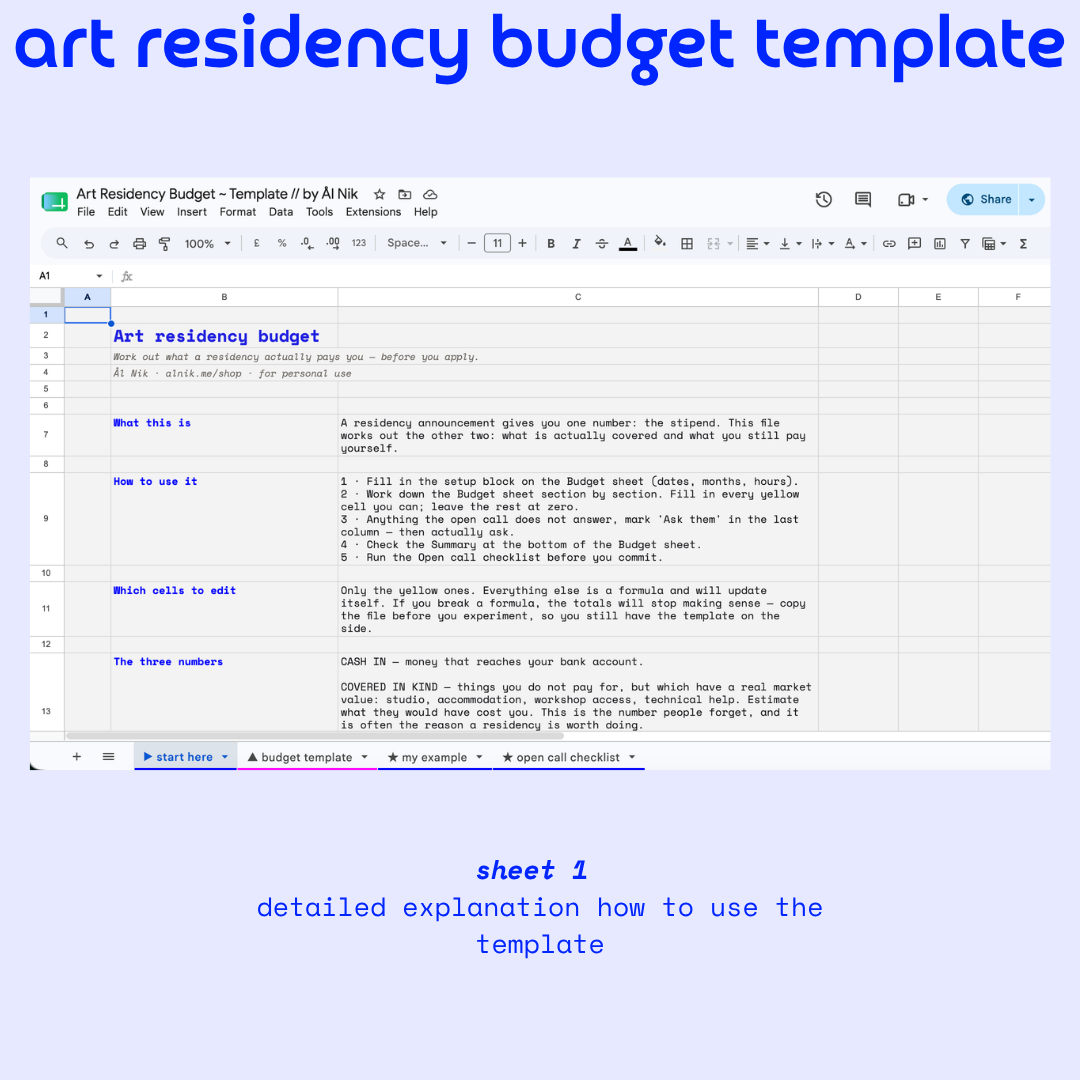 Image 1 of 4
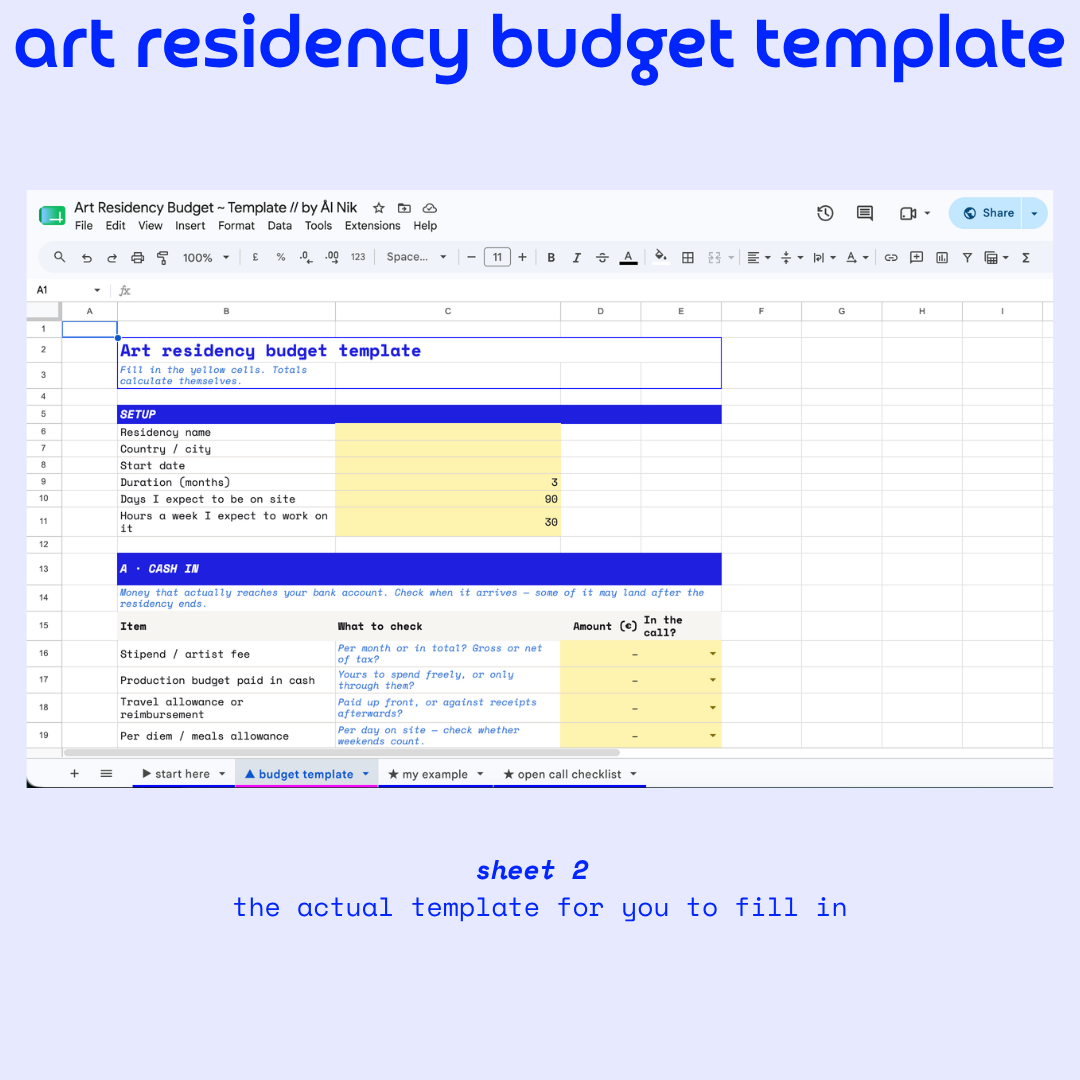 Image 2 of 4
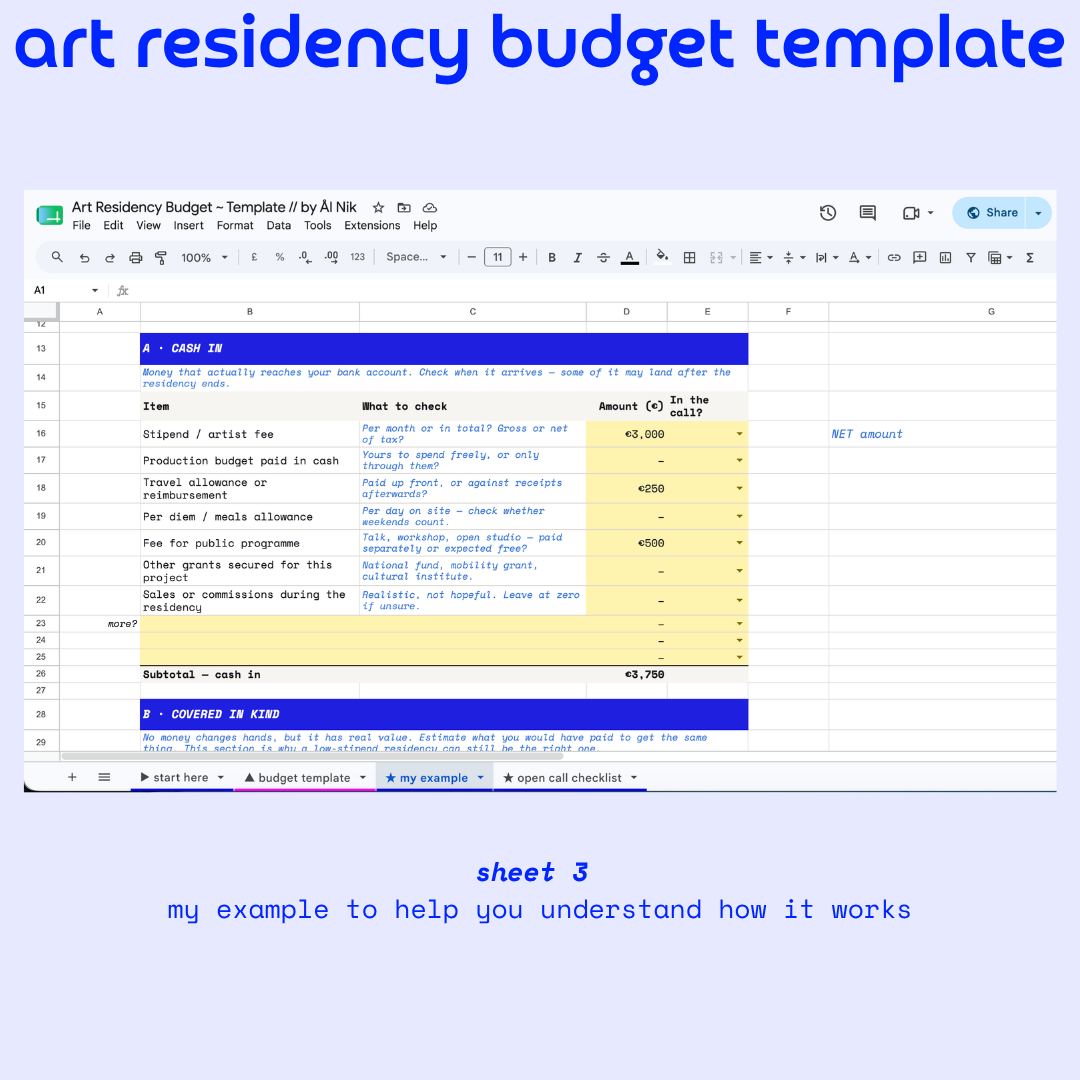 Image 3 of 4
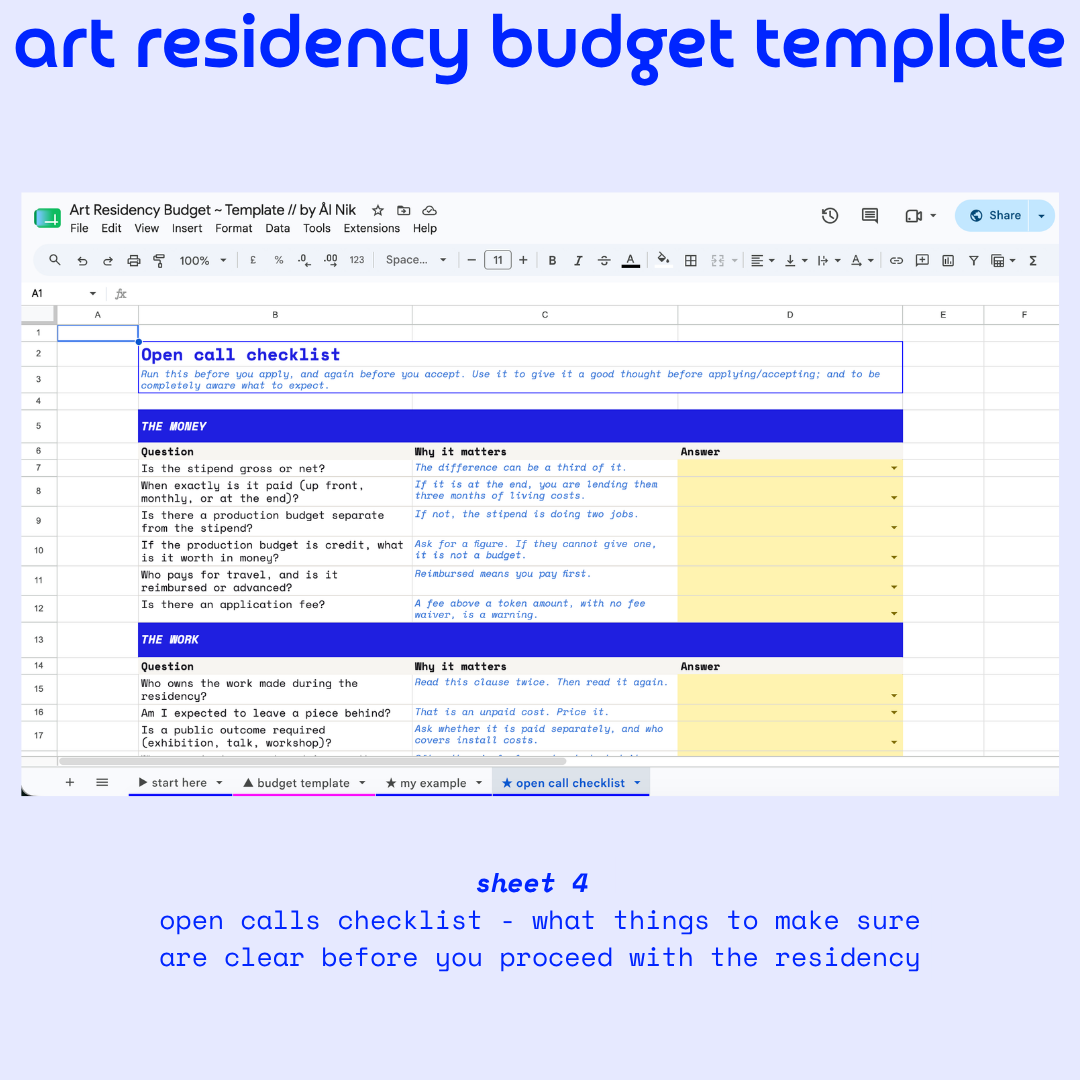 Image 4 of 4
An open call gives you one number: the stipend. It rarely tells you when that money arrives, what is covered, or what you will still be paying for at home while you are away.
I made this spreadsheet to really see the whole picture of an art residency in numbers and understand better what to expect and how to plan my financials.
This template does not tell you whether a residency is worth doing, but how much it will cost you, how much money you can get in the end, and what you can try negotiate in the process.
▲ Seven budget sections and 45 prompted lines: cash in, what is covered in kind, travel and logistics, production, living on site, what carries on at home, tax and admin;
▲ A column for what the open call actually says, so the gaps turn into questions you ask the organisers;
▲ A summary that calculates your net cash, your net including everything covered in kind, your income per month, your effective hourly rate, and how much more to ask for to break even;
▲ The in-kind section: studio, workshop access, accommodation, technical hours — the part most of us leave out, and the reason a low-stipend residency can still be the right one;
▲ The section nobody budgets for: rent, bills and income that carry on at home while you are away;
▲ My own budget as an example to help you understand how to use the template, filled in, with a note on how I estimated every figure;
▲ An open call checklist: 21 questions across the money, the work, the conditions, and the red flags;
▲ Formulas that do the arithmetic: you fill in the yellow cells, nothing else.
This picks up where The Supported Artist leaves off: a zine that helps you find the call and prepare the application; this one works out whether to accept it. If you also want to keep track of what you have applied for, the applications tracker is only 3.50 EUR.
▲ instant download
▲ 4 sheets: start here, budget template, my worked example, open call checklist;
▲ .xlsx, instant digital download (opens in Excel, Numbers and LibreOffice);
▲ A Google Sheets version is linked inside, if you would rather work in the browser, just make a copy of the document and fill it in for your next residency;
▲ Amounts in EUR, straightforward to change;
▲ Everything calculated, nothing typed in twice, change one number and the totals follow;
▲ First edition, 2026;
▲ Made with love in Sofia, Bulgaria.
Section G is a prompt, not advice. Stipends are treated differently depending on where you live, where the residency is, and whether the two countries have a treaty between them. Ask an accountant who knows both before you rely on the net figure.
Released under Creative Commons BY-NC-SA 4.0: you are invited and welcome to share and adapt it for non-commercial purposes, with credit, under the same licence. Sharing beats gatekeeping.
An open call gives you one number: the stipend. It rarely tells you when that money arrives, what is covered, or what you will still be paying for at home while you are away.
I made this spreadsheet to really see the whole picture of an art residency in numbers and understand better what to expect and how to plan my financials.
This template does not tell you whether a residency is worth doing, but how much it will cost you, how much money you can get in the end, and what you can try negotiate in the process.
▲ Seven budget sections and 45 prompted lines: cash in, what is covered in kind, travel and logistics, production, living on site, what carries on at home, tax and admin;
▲ A column for what the open call actually says, so the gaps turn into questions you ask the organisers;
▲ A summary that calculates your net cash, your net including everything covered in kind, your income per month, your effective hourly rate, and how much more to ask for to break even;
▲ The in-kind section: studio, workshop access, accommodation, technical hours — the part most of us leave out, and the reason a low-stipend residency can still be the right one;
▲ The section nobody budgets for: rent, bills and income that carry on at home while you are away;
▲ My own budget as an example to help you understand how to use the template, filled in, with a note on how I estimated every figure;
▲ An open call checklist: 21 questions across the money, the work, the conditions, and the red flags;
▲ Formulas that do the arithmetic: you fill in the yellow cells, nothing else.
This picks up where The Supported Artist leaves off: a zine that helps you find the call and prepare the application; this one works out whether to accept it. If you also want to keep track of what you have applied for, the applications tracker is only 3.50 EUR.
▲ instant download
▲ 4 sheets: start here, budget template, my worked example, open call checklist;
▲ .xlsx, instant digital download (opens in Excel, Numbers and LibreOffice);
▲ A Google Sheets version is linked inside, if you would rather work in the browser, just make a copy of the document and fill it in for your next residency;
▲ Amounts in EUR, straightforward to change;
▲ Everything calculated, nothing typed in twice, change one number and the totals follow;
▲ First edition, 2026;
▲ Made with love in Sofia, Bulgaria.
Section G is a prompt, not advice. Stipends are treated differently depending on where you live, where the residency is, and whether the two countries have a treaty between them. Ask an accountant who knows both before you rely on the net figure.
Released under Creative Commons BY-NC-SA 4.0: you are invited and welcome to share and adapt it for non-commercial purposes, with credit, under the same licence. Sharing beats gatekeeping.